
Twin Shaft Mixers With High Output
The core evaluation indicator for twin shaft mixer with high output is never the nominal value of the single discharge volume, but rather the stable and effective output per unit time. Many projects have the misconception that "large volume equals high output." In reality, the conversion rate from theoretical capacity to actual capacity depends on three core elements: mixing cycle efficiency, continuous operation reliability, and the matching degree of upstream and downstream systems. Haomei Machinery's JS series and SICOMA MAO series twin shaft mixers with 1m3 and above, relying on different technical tuning approaches, cover the high-capacity range of 50m3/h to 200m3/h, serving as the main capacity providers for large and medium-sized commercial concrete plants and infrastructure projects.
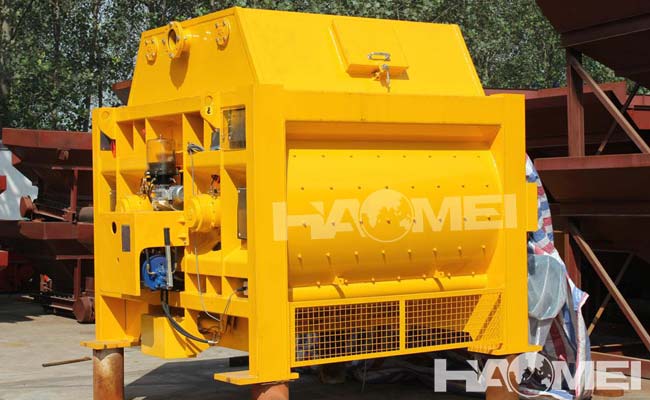
From the perspective of nominal capacity benchmarks, twin shaft mixer with high output form a tiered high-capacity layout.
The JS series twin shaft mixer, models with a capacity of 1m3 and above, includes the JS1000, JS2000, JS3000, and JS4000, with theoretical hourly capacities of 50m3, 100m3, 150m3, and 200m3 respectively. The standard cycle time is set at 72 seconds, with pure mixing time accounting for approximately 65%.
The SICOMA MAO series twin shaft mixer, including the MAO1000, MAO2000, MAO3000, and MAO4000, has a nominal theoretical capacity comparable to the JS series, but achieves higher actual production rates. Utilizing optimized flow field design, the standard cycle time is compressed to within 65 seconds, increasing actual hourly capacity by 10%~12% for the same volume. For high-volume projects, improving cycle efficiency offers a higher cost-effectiveness than simply increasing volume.
Mixing cycle efficiency is the core technology for achieving high output. A complete production cycle consists of three stages: feeding, mixing, and unloading. Optimizing the efficiency of the mixing stage is the core of technological differentiation. The JS series twin shaft concrete mixer employs a standard convection mixing architecture, with a 12-blade layout suitable for conventional concrete mix proportions. Its 60-second mixing time meets the homogeneity requirements for C30 and below, making it a mainstream choice for economical, high-yield solutions. The SICOMA MAO series twin shaft mixer, through its 16-blade staggered arrangement and optimal 0.74 pitch-to-diameter ratio, enhances material shear and convection intensity, reducing the time to achieve uniform mixing by over 15%. Even for high-strength concrete above C50, it maintains a complete cycle within 70 seconds, further amplifying its output advantage in high-grade production scenarios. Simultaneously, the unloading process utilizes a large-angle hydraulic unloading gate, controlling the unloading time for 1m3 concrete to within 8 seconds and for 4m3 concrete to no more than 12 seconds, minimizing non-productive time.
Continuous operational reliability determines the true ceiling of actual output. The core difference between theoretical capacity and actual on-site output lies in the equipment's effective operating rate. The JS series twin shaft mixers, with its standard configuration, boasts an average annual effective operating rate of approximately 82%. Planned downtime for tasks such as replacing wear parts and maintaining seals is relatively high, making it suitable for small to medium-sized projects with daily production hours of 12 hours or less. The SICOMA MAO series twin shaft mixers, relying on a multi-layer floating composite shaft end sealing system and Ni-Hard 530HB high-wear-resistant components, extends the single maintenance cycle to 6000 working hours, increases the lifespan of core wear parts by 45%, and achieves an annual effective operating rate exceeding 92%. It can stably support a 24-hour, three-shift continuous production mode, with a particularly significant output advantage in large-scale commercial concrete plants with an annual output of over 300,000 cubic meters.
High output cannot be achieved by a single unit alone; the coordination and matching of upstream and downstream systems are equally crucial. Twin shaft mixers support continuous batching mechanisms. The JS series twin shaft mixers, compatible with standard electrical control systems, meets basic coordination needs and controls overall plant construction costs. The SICOMA MAO series twin shaft mixers can be expanded with intelligent linkage control modules to achieve precise matching of aggregate feeding, powder metering, and mixing and unloading cycles, further reducing process standby intervals and increasing the overall capacity of the mixing line by 5% to 8%.
In summary, the selection of twin shaft mixer with high output should be based on actual production capacity rather than simply nominal volume. For projects with conventional capacity and intermittent production, the JS series twin shaft mixer provides a cost-effective solution; for high-strength continuous production and high-yield requirements for high-grade concrete, the SICOMA MAO series twin shaft mixer is more suitable, achieving stable high output through a dual improvement in cycle efficiency and operating rate.


