
Large Volume Twin Shaft Compulsory Mixer
A large volume twin shaft compulsory mixer is not simply a scaled-up version of a smaller model; rather, it is an engineered product resulting from a complete reconstruction of the mixing chamber, transmission system, and support structure. The industry typically categorizes large volume twin shaft compulsory mixers as those with a discharge volume of 1m3 or more. However, once the capacity exceeds the 1m3 threshold, material inertial load, main shaft deflection, and shaft end sealing pressure all increase non-linearly, rendering conventional design systems unsuitable. Haomei Machinery's JS and SICOMA MAO series fully cover large volume twin shaft compulsory mixer specifications from 1m3 to 4m3, serving as core supporting main units for commercial concrete plants and infrastructure projects.
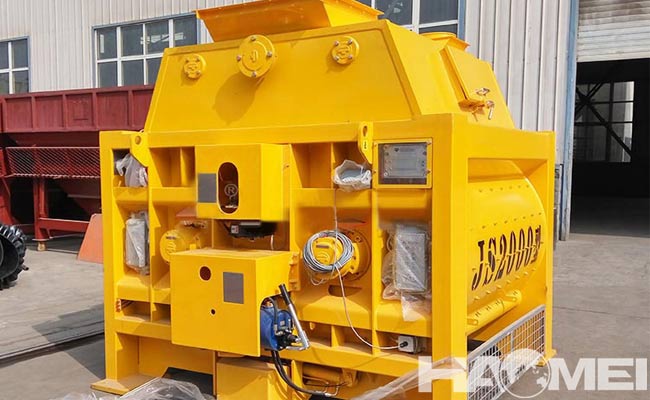
Large volume twin shaft compulsory mixer mainstream production specifications are divided into four levels: 1m3, 2m3, 3m3, and 4m3, forming a tiered capacity layout. The Haomei JS series twin shaft compulsory mixer models includes the JS1000, JS1500, JS2000, JS3000, and JS4000, with corresponding discharge volumes of 1.0m3, 1.5m3, 2.0m3, 3.0m3, and 4.0m3, and feed capacities of 1600L, 3200L, 4500L, and 6000L respectively. They are equipped with dual 18.5kW, dual 30kW, dual 45kW, and dual 55kW power supplies, with theoretical hourly capacities of 50m3, 100m3, 150m3, and 200m3, respectively. The SICOMA MAO series twin shaft compulsory mixer models includes the MAO1000, MAO2000, MAO3000, and MAO4000, with discharge volumes matching the JS series. Power configurations are dual 18.5kW, dual 30kW, dual 37kW, and dual 45kW, achieving lower power consumption at the same capacity through higher transmission efficiency and optimized flow field.
Enclosure rigidity is the first technical hurdle in large volume twin shaft compulsory mixer design, and the rigidity requirements increase progressively with the specifications. For 1m3 models, 8-10mm steel plates are sufficient, but for 3m3 and 4m3 models, standard thickness steel plates exhibit significant vibration deformation and weld fatigue risks. The JS series twin shaft mixer models uses a thickened steel plate welded structure with external reinforcing ribs and mesh; the 4m3 model's enclosure steel plate thickness reaches 16mm. The SICOMA MAO series twin shaft mixers, in specifications of 1.5m3 and above, adopts a box-type cast-welded composite body, with side plates undergoing stress-relief annealing treatment, increasing overall rigidity by over 35%. Under full load conditions, deformation in the 4m3 model is controlled within 0.2mm, ensuring the liner fitting accuracy and shaft coaxiality from the source. The spindle diameter also increases with the capacity. The 1m3 class spindle diameter is approximately 120mm, while the 4m3 class requires over 220mm. All SICOMA models use forged alloy steel spindles with a tensile strength ≥850MPa after heat treatment.
The shaft end sealing system is the component with the highest failure rate in large volume twin shaft compulsory mixer models and is also the core difference between the two series. The larger the material volume, the stronger the static pressure and permeation pressure of the slurry on the shaft end. While a conventional sealing structure can be used for the 1m3 class, an upgraded sealing system is necessary for volumes above 3m3. The JS series twin shaft compulsory concrete mixers employ a dual-combination structure of packing seal and skeleton oil seal, with a maintenance cycle of approximately 3000 working hours for the 1m3 class and reduced to 2000 hours for the 4m3 class. The SICOMA MAO series twin shaft mixers, utilizes a composite sealing system of multi-layer floating oil seals, wear-resistant bushings, and an automatic grease lubrication circuit, forming a continuous grease barrier. This results in a slurry leakage failure rate of less than 0.5%, with a stable maintenance cycle exceeding 6000 hours, suitable for 24-hour uninterrupted production.
The power transmission system also requires targeted enhancement. large volume twin shaft mixers can achieve a starting instantaneous torque of up to 2.5 times the rated value, with higher specifications exhibiting a more significant impact effect. The JS series uses a flexible coupling to buffer starting impact and is equipped with a standard industrial planetary reducer; the SICOMA MAO series, on the other hand, uses an original imported heavy-duty planetary reducer with a coaxial direct-drive structure, increasing transmission efficiency to over 95%, reducing starting impact by 30%, and achieving an average energy consumption that is approximately 15%~18% lower than the comparable JS model. Regarding the unloading system, all large-capacity models generally adopt hydraulic cylinder drive, with dual cylinders configured for 2m3 and above. The unloading gate opening angle reaches 130°, and the unloading time is controlled within 12 seconds.
From an engineering application perspective, 1m3 and 2m3 large volume twin shaft compulsory mixers are mostly used in small and medium-sized commercial concrete plants and engineering plants, where the JS series has a significant cost-performance advantage. 3m3 and 4m3 large volume twin shaft compulsory mixers are primarily used in environmentally friendly commercial concrete industrial parks with an annual production capacity of millions of cubic meters, as well as high-standard projects such as highways and nuclear power plants. The SICOMA MAO series offers more obvious stability and full-cycle cost advantages. Together, these two types constitute a complete tiered layout in the large-capacity mixing unit market.


