
2m3 Twin Shaft Concrete Mixer
Among the full range of twin-shaft concrete mixers, the 2m3 discharge specification is globally recognized as the "golden capacity range" and is the standard main model with the highest installed capacity in medium-sized commercial concrete batching plants and engineering concrete batching plants. Its core value lies in the optimal balance between capacity scale, plant construction investment, and operation and maintenance costs. Twin shaft concrete mixers can cover the capacity needs of most infrastructure and commercial concrete projects while avoiding the high initial investment and site barriers of larger-scale models. Haomei Machinery's JS2000 and SICOMA MAO2000 models correspond to two technology routes: an economical general-purpose model and an industrial-grade high-efficiency model, respectively, fully covering the differentiated procurement needs of the 2m3 specification.
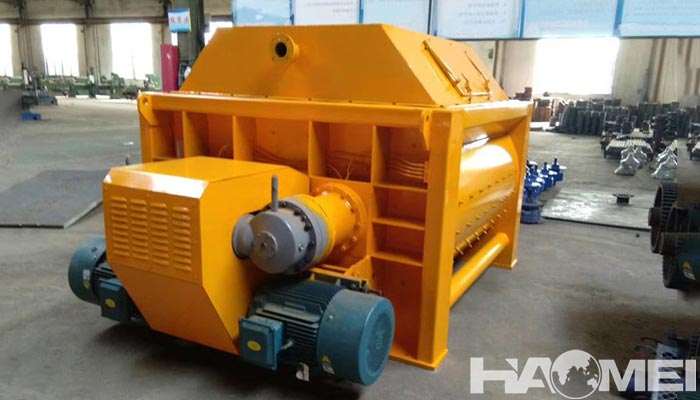
From the perspective of basic performance parameters, both models are anchored to the standard 2m3 discharge volume, but their design focuses differ. The JS2000 concrete mixer is a general-purpose standard design with a 3200L feed volume and a single-batch dense concrete output of 2000L. It features dual 30kW mixing motors, a standard mixing cycle of 72 seconds, and a theoretical hourly capacity of 100m3. It is compatible with the HZS120 concrete batching plant and is the mainstream choice for municipal engineering and small-to-medium-sized commercial concrete plants. The SICOMA MAO2000 concrete mixer adopts an industrial-grade optimized design with a 3000L feed volume and a 2000L output volume. It is equipped with dual 30kW motors and an imported coaxial direct-drive reducer. Utilizing a fluid dynamics-optimized mixing flow field, it compresses the standard cycle to 65 seconds, achieving a theoretical hourly capacity of over 110m³. This represents an approximately 12% increase in capacity efficiency at the same installed power, making it more suitable for high-load continuous production scenarios.
The differentiation in technical approaches within the same specifications is the most significant market characteristic of 2m3 twin shaft concrete mixer models. In terms of structural design, the JS2000 concrete mixer adopts a thickened steel plate integral welded housing with added longitudinal and transverse stiffeners to enhance rigidity. The shaft end features a dual protection structure of packing seal and skeleton oil seal, paired with 12 high-chromium alloy stirring blades. The design logic prioritizes structural simplification and manufacturing cost control, resulting in high spare parts versatility and low replacement costs per part. The SICOMA MAO2000 concrete mixer, on the other hand, uses a box-type cast-welded composite body, which undergoes high-temperature stress-relief annealing to eliminate welding stress, resulting in lower deformation during long-term heavy-load operation. The shaft end is equipped with a multi-layer floating oil seal composite sealing system and a fully automatic centralized lubrication circuit, forming a continuous grease barrier. Combined with 16 staggered Ni-Hard 530HB wear-resistant blades, material mixing is more uniform, the service life of core vulnerable parts is increased by more than 45%, and the overall slurry leakage failure rate is controlled to within 0.5%.
From an engineering adaptability perspective, the 2m3 concrete mixer offers significant advantages in terms of versatility. Compared to the 1.5m3 concrete mixer model, its single-tank capacity increases by 33%, while the overall construction cost of the mixing plant only increases by about 20%, demonstrating significant economies of scale. Compared to the 3m3 concrete mixer, its site footprint is reduced by 25%, significantly reducing the difficulty of equipment hoisting, shipping, and installation, and shortening the investment payback period by more than 15%. It is the optimal capacity choice for most commercial concrete plants and medium-sized infrastructure projects in prefecture-level markets. Specifically, regarding the different application scenarios for the two models, the JS2000 concrete mixer, with its higher cost-effectiveness, is widely used in conventional conditions such as ordinary commercial concrete, municipal roads, and building construction, especially suitable for intermittent production projects with a daily production time of less than 12 hours. The SICOMA MAO2000 concrete mixer, with its higher continuous operation stability and lower full-cycle maintenance costs, has become the first choice for commercial concrete plants with an annual output of over 300,000 cubic meters and high-strength concrete production projects of C50 and above, and enjoys higher recognition in high-load production markets overseas such as the Middle East and Southeast Asia.
In summary, the core competitiveness of the 2m3 twin shaft concrete mixer in the market has never been about stacking the most powerful parameters, but rather its precise adaptability to various application scenarios. The JS2000 and SICOMA MAO2000 concrete mixer models, with their core advantages of cost-effectiveness in initial purchase and long-term operational stability, respectively, cover all mainstream procurement needs within the 2m3golden capacity range. Project owners can flexibly choose the model based on production intensity, concrete grade, and investment budget.


