
Different Types of Twin-Shaft Concrete Mixers
Twin-shaft concrete mixers—formally known as twin-shaft forced-action concrete mixers—serve as the core mixing units for commercial ready-mix plants and infrastructure construction projects. In the industry, twin shaft mixers are typically classified according to four key criteria: capacity, technical positioning, power source, and intended application— correspond to distinct performance parameters and application scenarios. Haomei Machinery offers a comprehensive product line of twin-shaft mixers, encompassing both the economical, general-purpose JS series and the high-end, industrial-grade SICOMA MAO series, designed to meet diverse procurement requirements across various project scales.
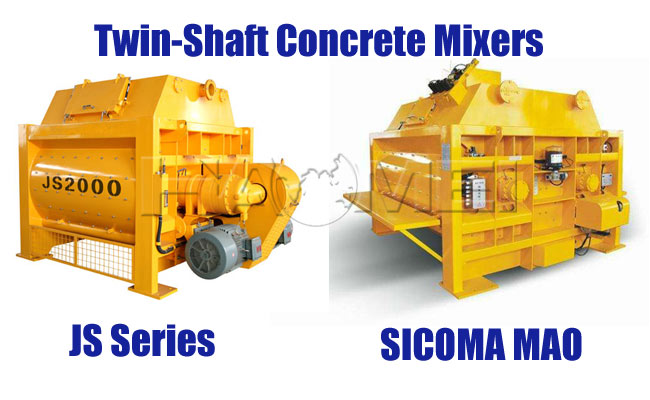
Categorized by capacity, twin shaft mixers addresses the full spectrum of production needs.
Small-scale models feature a discharge capacity of 1m³ or less; representative models include the JS500, JS750, and JS1000—offering discharge volumes of 500L, 750L, and 1000L, respectively, with a theoretical hourly output of 25–50m³. These are well-suited for small-scale precast component plants and rural infrastructure projects. Within the SICOMA MAO series, the MAO1000 model offers superior mixing efficiency, making it an ideal choice for high-quality, small-scale projects.
Medium-sized models feature a discharge capacity of 1.5–2 m³. Representative models include the JS1500 and JS2000, which offer an hourly production capacity of 75–100 m³; the SICOMA MAO1500 and MAO2000 models provide a 10%–12% increase in capacity for the same nominal size. Based on extensive experience in supporting overseas projects, the 2 m³ capacity class is the most widely installed globally, accounting for approximately 42% of the market. It offers the optimal balance between production capacity and initial plant investment, making it the standard choice for medium-scale commercial ready-mix concrete plants.
Large-scale models feature a discharge capacity of 3–4 m³. Representative models include the JS3000 and JS4000, with an hourly capacity of 150–200 m³; the SICOMA MAO3000 and MAO4000 models, with equivalent capacities, are designed for large-scale commercial concrete industrial parks (with annual outputs in the million-cubic-meter range) and major infrastructure projects, such as highways and bridges.
In terms of technical positioning, two distinct technological approaches cater to different quality requirements.
The "general-purpose/economical" category is represented by the JS series. These twin shaft mixers come standard with high-chromium alloy wear-resistant liners and mixing blades, a dual-sealing system (combining skeleton oil seals with packing), and standard planetary gearboxes. Featuring a mature and widely adopted design, they offer low spare-part procurement costs and are well-suited for standard concrete production and budget-sensitive projects.
The "high-end industrial" category is represented by the SICOMA MAO series twin shaft mixers. These models utilize Ni-Hard 530HB (high-wear-resistant cast iron) components, a multi-layer floating oil seal system, and imported heavy-duty coaxial direct-drive gearboxes. This configuration extends the service life of wear parts by 45% and keeps the failure rate due to slurry leakage below 0.5%, making them ideal for high-intensity, continuous production and the manufacturing of high-grade concrete.
Regarding power systems, equipment can be configured to suit various power supply conditions.
Electric motor-driven units are the mainstream standard; they utilize three-phase asynchronous motors to ensure stable rotational speeds. With a transmission efficiency of 88%–95% and low energy consumption per unit of output, these models are best suited for stationary concrete mixing plants located in areas with a stable power grid.
Diesel-powered models are custom-engineered solutions; they utilize a single, high-output diesel engine paired with a transfer case to drive both shafts simultaneously. Eliminating the need for an external power grid, these units offer substantial low-speed torque reserves, making them ideal for mobile batching plants and temporary construction projects in remote areas—such as off-road sites or water conservancy dam projects—where a reliable power supply is unavailable.
Different site requirements call for distinct plant configurations.
Models designed for stationary concrete mixing plants feature standard frames and industry-universal interfaces, allowing for seamless integration with batching, metering, and conveying systems—an ideal solution for commercial ready-mix concrete plants and precast component factories with long-term, fixed-site operations.
Conversely, models designed for mobile concrete mixing plants feature an optimized structural weight and compact installation dimensions; these are compatible with trailer-mounted or truck-mounted configurations, effectively meeting the needs of projects that require frequent relocation.
Different types of twin-shaft mixers are tailored to specific operational scenarios, with the optimal choice depending on how well the equipment aligns with the project's working conditions. Haomei Machinery offers customized selection solutions based on factors such as project capacity, concrete grade, power supply conditions, and the specific plant setup. Our entire product range complies with CE and ISO certification standards, meeting the regulatory requirements for construction projects in most countries worldwide.


