
Twin Shaft Concrete Mixer Price System
The price of twin shaft concrete mixers is not a single value, but a multi-dimensional pricing system comprised of technological routes, specification levels, configuration gradients and trade terms. Haomei Machinery, as an exporter, offers two main series: the JS economy model and the SICOMA MAO industrial-grade model, forming a clear price tier and covering a full range of capacities from 0.5m³ to 4m³.
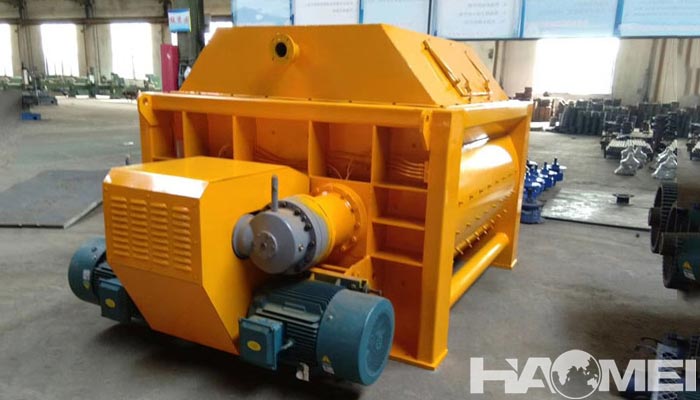
From the perspective of basic pricing anchors, discharge volume is the core basis for dividing price gradients. As a general-purpose economic route, the JS series has FOB Qingdao prices that increase linearly with specifications: JS500 concrete mixer(0.5m³ output) approximately US$6,800~7,500, JS750 concrete mixer approximately US$9,200~10,500, JS1000 concrete mixer approximately US$12,800~14,200, JS1500 concrete mixer approximately US$18,500~20,000, JS2000 concrete mixer approximately US$24,000~26,500, JS3000 concrete mixer approximately US$28,000~31,500, and JS4000 concrete mixer approximately US$36,000~39,500.
SICOMA's MAO series is positioned as a high-end industrial-grade product, with a stable premium of 22% to 30% for the same specifications: MAO1000 concrete mixer approximately US$16,500 to US$18,000, MAO1500 concrete mixer approximately US$23,000 to US$25,500, MAO2000 concrete mixer approximately US$30,000 to US$33,000, MAO3000 concrete mixer approximately US$34,800 to US$37,500, and MAO4000 concrete mixer approximately US$44,000 to US$48,000. The premium primarily comes from the increased cost of core components such as imported reducers, composite shaft end seals, and high-wear-resistant liners.
Configuration level is the second variable in price fluctuations, and the industry-standard premium coefficient can be quantified. The wear-resistant system is upgraded to Ni-Hard 530HB high-chromium cast iron, increasing the price by 8%~12%, corresponding to a service life extension of over 45%; the optional high-pressure automatic cleaning system costs an additional $800~$1,500, increasing depending on the model and specifications; the intelligent electronic control system (including weighing, fault diagnosis, and data networking modules) costs an additional $2,500~$4,000; the variable frequency speed control drive module costs an additional $3,000~$5,000, which can reduce starting shock and save approximately 15% on energy. In addition, the separate cost for CE certification, ISO third-party testing, and other compliance documents is approximately $800~$1,500, which is mandatory for customs clearance in some countries.
Trade terms directly affect the total landed cost. FOB Qingdao is the industry benchmark price, while EXW factory delivery price is 6%~9% lower, mainly deducting inland transportation and customs port charges. CIF terms require additional ocean freight and insurance. For example, the ocean freight for a single 20-foot container is approximately US$1,200-1,800 for Southeast Asia routes, US$2,000-2,800 for Middle East routes, and US$3,000-4,000 for West Africa routes. Bulk purchases of full containers can reduce unit logistics costs by 15%-20%. Payment methods also affect the final transaction price; spot letters of credit add 2%-3% to the price, while higher T/T prepayment ratios offer greater negotiation space.
From a life-cycle cost model perspective, the initial purchase price accounts for only 55%-65% of the total cost over five years. Although the SICOMA MAO series has a purchase premium of approximately 25%, it reduces the average annual consumption of vulnerable parts by 40% and downtime by 60%. Based on an annual production capacity of 200,000 cubic meters, the difference in maintenance costs over five years can reach US$12,000-18,000. Combined with energy savings, the total life-cycle cost is actually lower than the JS series under high-load continuous production scenarios. Conversely, for intermittent construction projects with an annual production capacity of less than 80,000 cubic meters, the JS series offers a better cost recovery period due to its lower initial investment.
In summary, the pricing of twin shaft concrete mixers requires a comprehensive calculation considering three dimensions: production capacity, operating conditions, and service life, rather than simply comparing prices. Haomei's tiered pricing system for its two series can cover different budgets and technical requirements. Project owners can match the appropriate technical approach and configuration level according to their needs to achieve the optimal balance between procurement costs and long-term benefits.


