
Twin Shaft Concrete Mixer 2m3 Price in USD
In the full spectrum of twin shaft forced concrete mixers, 2m3 discharge capacity is the most widely installed and most valuable specification globally, and also the model with the most significant price differentiation. For twin shaft concrete mixer 2m3 prices in the markets can vary by as much as 40%, easily leading buyers into the misconception of "comparing prices for the same capacity." Haomei Machinery's JS2000 and SICOMA MAO2000 represent two major technology routes: economical general-purpose and industrial-grade high-efficiency, respectively. Their price differences fully reflect the value stratification logic of 2m3 concrete mixer products.
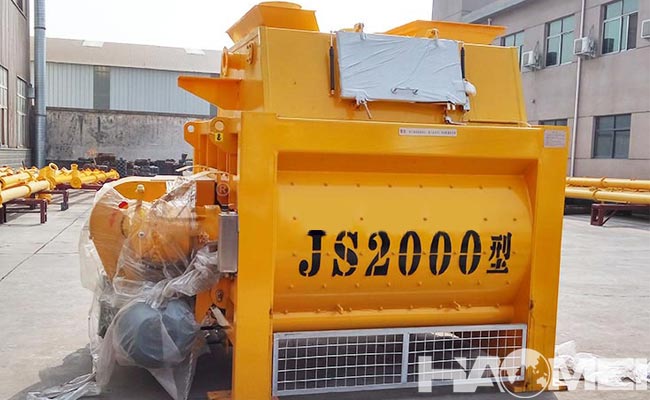
From the benchmark pricing, the two models form a clear price tier. The JS2000 concrete mixer FOB Shanghai price is US$24,000–26,500/unit, targeting the general-purpose economy market. It comes standard with dual 30kW motors, high-chromium alloy wear-resistant parts, dual shaft end seals, and a basic electrical control system, suitable for most conventional concrete production scenarios. The SICOMA MAO2000 concrete mixer FOB Shanghai price is US$30,000–33,000/unit, targeting the high-end industrial market. The price difference between the two models' standard configurations is approximately US$6,000–6,500, representing a premium of about 25%. Price fluctuations are mainly affected by optional modules, purchase volume, and payment method. Bulk purchases of 3 units or more can enjoy tiered discounts of 8%–10%. Customized intelligent electrical control, high-pressure cleaning, and other modules will incur additional charges.
The core components of the price difference can be broken down into four major hardware cost items, each corresponding to quantifiable performance differences.
Firstly, regarding the reduction gear transmission system, the SICOMA MAO2000 uses an original imported coaxial direct-drive planetary reducer, costing approximately $3,000 more per unit, but increasing transmission efficiency to over 95% and reducing starting impact by 30%. The JS2000 concrete mixer uses a domestically produced standard planetary reducer connected via a flexible coupling, with a mature structure and inexpensive spare parts.
Secondly, regarding the shaft end sealing system, the SICOMA multi-layer floating oil seal + automatic lubrication circuit configuration costs approximately $800 more, reducing the slurry leakage failure rate from 3% to below 0.5%, and doubling the maintenance cycle.
Thirdly, regarding the wear-resistant system, the Ni-Hard 530HB high-hardness cast iron liner blades cost approximately $1,200 more than ordinary high-chromium alloy blades, but extend service life by 45%.
Fourthly, regarding the chassis manufacturing process, the cast-welded composite housing + stress-relief annealing treatment costs approximately $1,000 more, but reduces long-term heavy-load deformation by 35%. These four items total approximately $6,000, which is basically in line with the actual market price difference.
From a life-cycle perspective, the initial purchase premium can be offset by operating cost savings. In terms of energy consumption, the SICOMA MAO2000 concrete mixer's transmission efficiency advantage reduces energy consumption per unit capacity by approximately 15%, resulting in annual electricity cost savings of approximately US$1,200 based on 300 days of operation per year and an average of 12 hours per day. Regarding maintenance costs, the reduced frequency of replacement of wear-resistant parts and seals leads to annual consumable savings of approximately US$1,500. In terms of downtime losses, a 60% reduction in downtime due to malfunctions avoids annual losses of approximately US$1,800 based on the hourly output value of a commercial concrete plant. These three factors combined result in annual savings of approximately US$4,500, which, under high-load continuous production scenarios, can cover the initial purchase price difference within 1.5–2 years.
Based on this, a clear procurement decision can be derived. If the project's average daily production time is less than 10 hours, annual production capacity is less than 150,000 cubic meters, and the main product is ordinary concrete of C30 grade and below, the JS2000 concrete mixer offers a significant cost-performance advantage and a shorter investment recovery period. For projects operating for more than 16 hours daily, with an annual production capacity exceeding 200,000 cubic meters, and routinely producing high-strength concrete of grade C50 or higher, or located in areas with limited overseas component supply, the full-cycle cost advantage of SICOMA MAO2000 concrete mixer becomes even more pronounced. Simply judging selection based on "price" is unscientific; matching the appropriate grade to production intensity and operating conditions is crucial to achieving the optimal return on investment.


