
SICOMA Mixer VS JS Series Twin Shaft Mixer
In the field of twin shaft forced concrete mixing equipment, the SICOMA MAO series and the traditional JS series are the two mainstream main models in the industry, widely used in core scenarios such as ready mix concrete, large-scale infrastructure projects, and precast component production. Both of them adopt the twin shaft forced mixing principle, generating a combined mixing effect of shearing, convection, and diffusion through the counter-rotating of the two shafts, meeting the production requirements of C10-C80 strength grade concrete. The following systematically compares the two from the dimensions of core structure, performance parameters, and applicable scenarios, providing professional decision-making reference for engineering procurement.
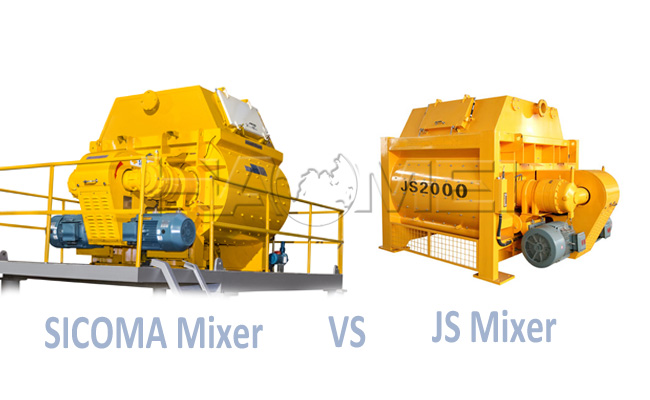
1. Core Similarities of SICOMA Mixer and JS Series Twin Shaft Mixer
- Both employ the same mixing principle:
Both adopt a twin-shaft forced mixing design, with the two shafts rotating in opposite directions, driving the mixing blades to form a three-dimensional mixing flow field. Materials are rapidly and uniformly mixed through shearing, extrusion, and tumbling. The standard mixing cycle is 60-90 seconds, and the homogeneity meets the national standard GB/T10171 and the European standard EN206.
- Basic Configuration Commonality:
Core components include a mixing tank, dual main shafts, mixing arms, mixing blades, a reduction system, lubrication device, and unloading mechanism. They support extended functions such as high-pressure cleaning and material temperature monitoring, and are compatible with both stationary and mobile mixing plants.
- Overlapping Capacity Coverage:
The SICOMA MAO series (MAO1000-MAO4000) and JS series (JS500-JS4000) both cover an effective discharge capacity range of 0.5m³-4.0m³, with power configurations increasing with specifications, adapting to mixing plant capacity requirements of 50-240m³/h.
- International Certification Compatibility:
Mainstream products are CE and ISO9001 certified, and key components meet international safety and quality standards, adapting to engineering bidding requirements in most countries worldwide.
2. Core Performance and Structural Differences:
The two models exhibit significant differences in mechanical structure and process design.
The SICOMA MAO series concrete mixer adopts an integral box-type cast-welded structure cavity, treated with a high-temperature stress-relief annealing process to effectively eliminate welding internal stress. It can withstand continuous heavy-load operation for 24 hours a day without structural deformation risk. The shaft end is equipped with a multi-layer floating oil seal composite sealing system, coupled with a fully automatic centralized lubrication circuit, achieving continuous pressure protection at the sealing parts, keeping the overall slurry leakage failure rate below 0.5%. The main shaft uses a split plug-in stirring arm structure, paired with 16 highly wear-resistant blades with a layout optimized based on fluid dynamics simulation. This ensures uniform material friction loss and significantly reduces the wear rate in core vulnerable areas.
In contrast, the traditional JS series concrete mixer generally uses a conventional welded cavity without stress-relief processes, making it prone to structural deformation under long-term high-load operation. The shaft end uses a traditional skeleton oil seal combination sealing structure, resulting in weaker sealing durability and shorter maintenance cycles. Combined with an integral welded stirring arm and 12 standard blades, it exhibits significant shortcomings in material mixing efficiency and wear resistance stability.
The differences in power transmission and energy efficiency are significant.
Taking the industry-standard JS3000 model as a reference, both have a standard single-batch output of 2000L. The SICOMA MAO3000 is equipped with dual 37kW dedicated mixing motors, matched with an imported coaxial direct-drive planetary reducer, resulting in minimal power transmission loss and an overall energy consumption reduction of 18% compared to the JS3000 model of the same specifications, demonstrating significant energy-saving advantages. The JS3000 model is equipped with dual 45kW motors, offering higher power reserves and a larger feed volume, making it more suitable for mixing special raw materials such as large-diameter aggregates and high sand content. Meanwhile, the SICOMA series adopts a lightweight integrated structure design, with the same specifications of the entire machine weighing 1.2 tons less than the JS series, effectively reducing the costs of equipment transportation, on-site hoisting, and installation.
3. Differences in Operation and Maintenance Costs, Pricing, and Applicable Scenarios
The two models show significant differentiation in their positioning regarding full life-cycle operation and maintenance and market pricing. Regarding wear-resistant parts, the entire SICOMA series concrete mixer uses 530HB ultra-high hardness Ni-Hard wear-resistant cast iron, with core components having a service life of 80,000-100,000 mixing tank cycles, reducing annual maintenance costs by 40%. The JS series concrete mixer uses conventional high-chromium manganese alloy wear-resistant materials, with parts having a service life of only 50,000-60,000 mixing tank cycles. While the unit purchase cost is low, the replacement frequency is high, resulting in higher overall long-term maintenance costs.
In terms of market pricing, the SICOMA MAO series is positioned as mid-to-high-end industrial-grade equipment, with the MAO3000 model priced between US$38,000 and US$42,000, emphasizing high stability, low failure rate, and long lifespan industrial-grade performance. The JS series is positioned as economical general-purpose equipment, with the same specifications priced between US$28,000 and US$35,000, suitable for infrastructure projects with strict budget controls.
4. Professional Selection Recommendations
Based on engineering practice and equipment compatibility logic, both SICOMA mixer and JS mixers have clear operational condition compatibility boundaries.
For applications requiring long-term continuous production and high mixing precision, such as high-strength specialty concrete, large bridges, precast components for nuclear power plants, and high-standard commercial concrete industrial parks, SICOMA MAO series concrete mixers are the preferred choice. Their structural stability, mixing homogeneity, and durability meet the stringent standards of high-end projects.
For general municipal infrastructure, small precast component processing, and short-term temporary construction, JS series concrete mixers fully meet production needs and offer a higher cost-performance advantage. Equipment selection for engineering projects must be based on project operating conditions, production intensity, and budget planning to achieve a precise match between equipment performance and project requirements, maximizing the benefits of project deployment.


