
JS Series Concrete Mixer Manufacturer: Haomei Machinery
The JS series twin-shaft mixer is the most widely used type of primary mixing unit in ready-mix concrete plants and precast concrete facilities. The series ranges from the JS500 to the JS4000, corresponding to concrete batching plant capacities from HZS25 to HZS240. Haomei Machinery was among the early JS concrete mixer manufacturers, we offer the full range of models and have been exporting them internationally for many years. When comparing products from different manufacturers, the key factors that truly determine performance are specific technical parameters, the configuration of critical components, and quality inspection standards.
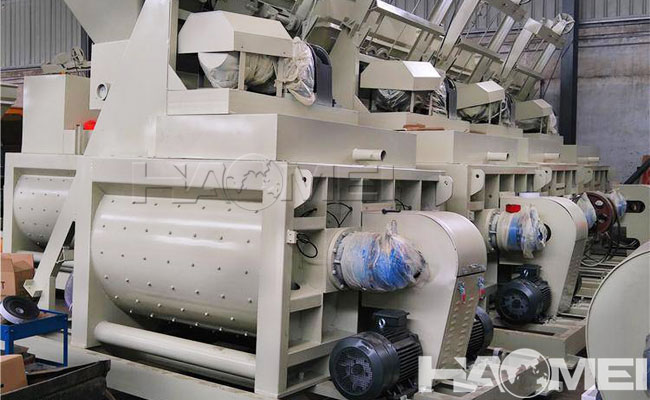
How Twin Shafts Achieve Uniform Mixing?
The JS series concrete mixer utilizes a design featuring two horizontal mixing shafts that rotate in opposite directions at the same speed. Mixing arms are arranged in a staggered, helical pattern; as materials move between the two shafts, they undergo both radial shearing and axial pushing, ensuring a homogeneous mix within a single operating cycle.
The service life of the equipment largely depends on the quality of its wear parts and sealing systems. The mixing blades and arc-shaped liner plates are crafted from high-chromium, wear-resistant cast iron. During assembly, the gap between the blades and the liners is kept within 5 mm to minimize material buildup inside the mixing drum. The mixing drum itself undergoes an aging treatment after welding to ensure precise center-to-center spacing and coaxiality of the two main shafts. The shaft ends feature a multi-layered sealing system reinforced by grease protection; a centralized electric lubrication pump delivers grease independently to each of the four shaft ends, significantly reducing the need for routine maintenance. The drive system utilizes a direct-coupled gearbox, resulting in a compact design and low operational noise. The discharge door is hydraulically operated, with an adjustable opening angle; it is also equipped with a manual emergency mechanism, allowing for discharge even during a temporary power outage.
Models and Key Specifications
The core specifications for the various models in the JS series concrete mixers are roughly as follows, with definitions being fairly consistent across different manufacturers:| Model | Feeding Capacity | Discharging Capacity | Theoretical Productivity | Mixing Motor Power | Mixing Shaft Speed Max. | Aggregate Size (Pebbles/Crushed Stone) | Common Plant |
| JS500 | 800 L | 500 L | 25 m³/h | 18.5 kW | 35 r/min | 80/60 mm | HZS25 |
| JS750 | 1200 L | 750 L | 35 m³/h | 30 kW | 31 r/min | 80/60 mm | HZS35 |
| JS1000 | 1600 L | 1000 L | 50 m³/h | 2×18.5 kW | 25.5 r/min | 80/60 mm | HZS50 / HZS60 |
| JS1500 | 2400 L | 1500 L | 75 m³/h | 2×30 kW | 25.5 r/min | 80/100 mm | HZS75 / HZS90 |
| JS2000 | 3200 L | 2000 L | 100 m³/h | 2×37 kW | 23 r/min | 80/100 mm | HZS120 |
| JS3000 | 4800 L | 3000 L | 150 m³/h | 2×55 kW | 21 r/min | 80/120 mm | HZS180 |
| JS4000 | 6400 L | 4000 L | ≥200 m³/h | 2×75 kW | 21 r/min | 120/100 mm | HZS240 |
In this table, the "discharge capacity" determines the volume of concrete produced per batch, while the "shaft rotation speed" dictates the intensity of the mixing action. Models ranging from JS500 to JS750 are suitable for small-scale construction sites and precast component plants; the JS1000 and JS1500 serve as the primary workhorses for commercial ready-mix concrete plants; and models from the JS2000 upward are intended for large-scale commercial concrete operations and hydraulic engineering projects. Theoretical output is calculated based on a 60-second cycle; however, in actual operation, the time required for loading and discharging means the actual output will be lower than the nominal capacity. When selecting equipment, it is prudent to estimate at 85% of the nominal value and then include an additional 10% margin.
Selection suggestions
In the overseas projects I have been exposed to, the most common problem is not that the machine is wrongly selected, but that the supporting equipment is not kept up. For JS3000 upwards, be careful with gravel with an aggregate particle size exceeding 80 mm, as it will accelerate blade wear; for dry hard concrete or low-slump materials, make sure the shaft speed and motor power match, and not just look at the tank size; the basic layout of the belt conveyor loading and the lifting hopper loading are completely different. Before setting the machine, send the site plan to avoid later rework.Another little experience: the shaft end seal and lining plate are the first components to have problems in continuous production. Buying spare parts in complete sets at one time is much cheaper than shipping individual parts by air later.
Haomei’s JS series concrete mixers are shipped in containers and can be equipped with motors tailored to specific voltage requirements and 50/60 Hz frequencies. We offer on-site installation guidance from our engineers, and common wear parts are kept in stock. Simply provide Haomei with your required hourly output, aggregate particle size, concrete grade, and local power supply specifications, and our technical team will recommend the appropriate mixer model, provide a comprehensive equipment list, and draft a site layout plan.


