
How Does A Twin Shaft Mixer Work? Workflow From Power Input to Finished Product Discharge
The twin shaft mixer serves as the core unit in ready mix concrete plants and engineering concrete batching plants. Its working cycle comprises three continuous stages: power torque transmission, material mixing within the chamber, and closed-loop sealing/protection. The parameter alignment across these stages directly determines the homogeneity of the finished product and the equipment's service life.
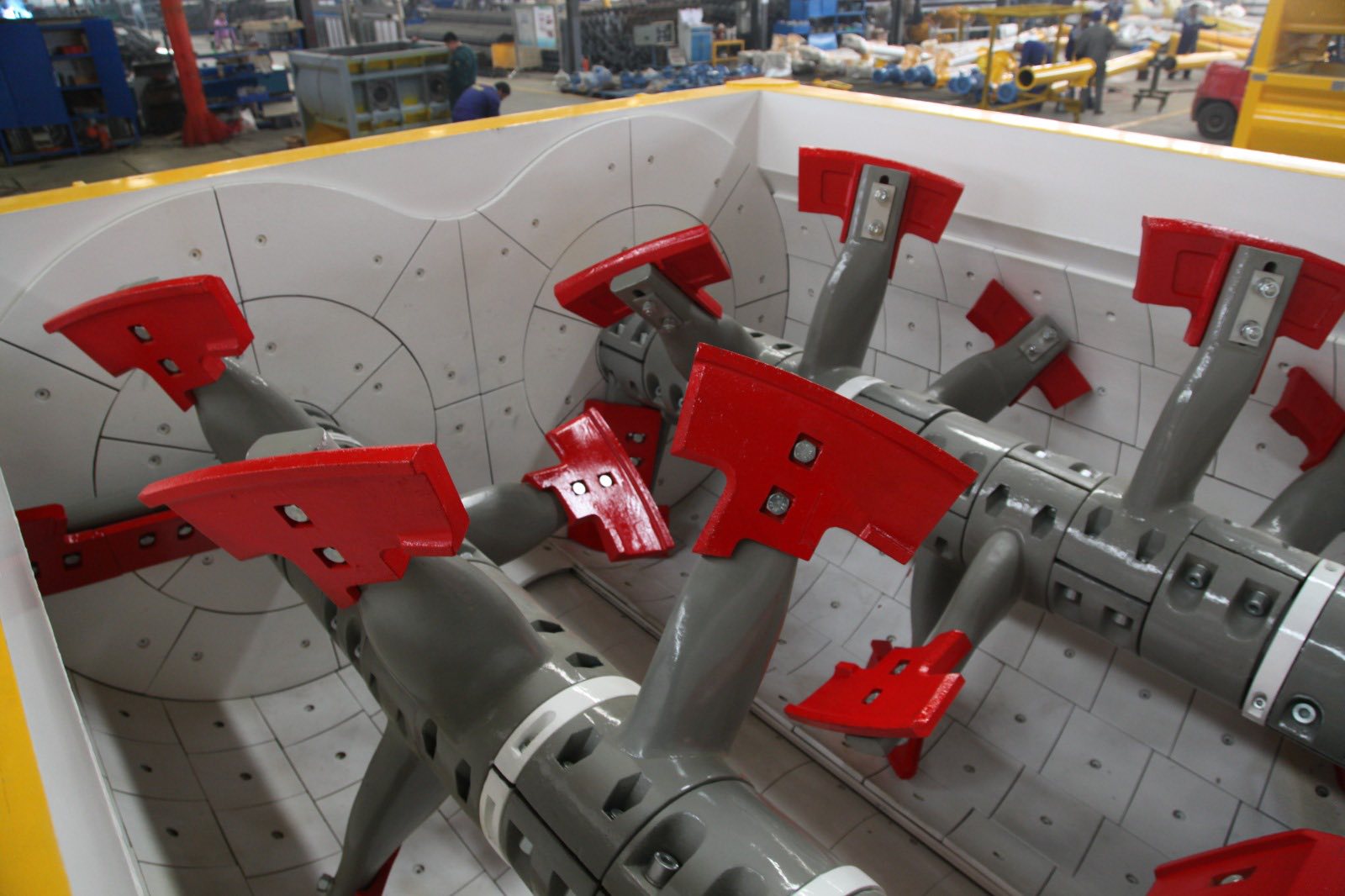
The power input stage establishes the energy foundation for the machine's operation. A three-phase asynchronous motor converts electrical energy into rotational mechanical energy; the rated torque is amplified via a reduction mechanism to synchronously drive two parallel main shafts in counter-rotation. The JS series twin shaft concrete mixer utilizes an elastic coupling to connect a standard planetary gearbox, achieving a transmission efficiency of approximately 88% with stable torque output suited for standard production conditions. In contrast, the SICOMA MAO series twin shaft mixer employs a heavy-duty planetary gearbox with a coaxial direct-drive configuration, eliminating intermediate transmission components; this boosts transmission efficiency to over 95%, increases output torque by 8% for the same power input, and reduces instantaneous startup shock by 30%. Main shaft speeds are stabilized between 30 and 35 rpm, with blade linear speeds controlled at 1.6–2.2 m/s, balancing the requirements for material shear strength and the control of component wear rates.
Material mixing within the chamber is the core of the workflow of twin shaft mixer, proceeding dynamically through three continuous phases. The initial 0–15 seconds constitute the "coarse mixing" phase, where the twin-shaft blades drive the materials to create opposing radial flows, breaking up the initial stratification of aggregates and powders. The 15–50 second interval is the "primary homogenization" phase; blades angled at 35°–40° axially propel the material in a reciprocating cycle. Through the combined effects of shearing, convection, and gravitational free-fall, the cement paste uniformly coats the aggregate surfaces. Finally, the 50–70 second period is the "stabilization and discharge" phase, during which admixtures are fully dispersed and the concrete's workability becomes consistent. The SICOMA MAO series twin shaft concrete mixer achieves a 72% ratio of high-intensity convection zones within the mixing chamber—thanks to an optimal pitch-to-diameter ratio of 0.74 and a 16-blade staggered layout—reducing the standard cycle time to 65 seconds. In contrast, the JS series twin shaft mixer utilizes 12 equidistant blades and a pitch-to-diameter ratio of 0.80, resulting in a standard cycle time of 72 seconds that aligns with conventional concrete production rhythms.
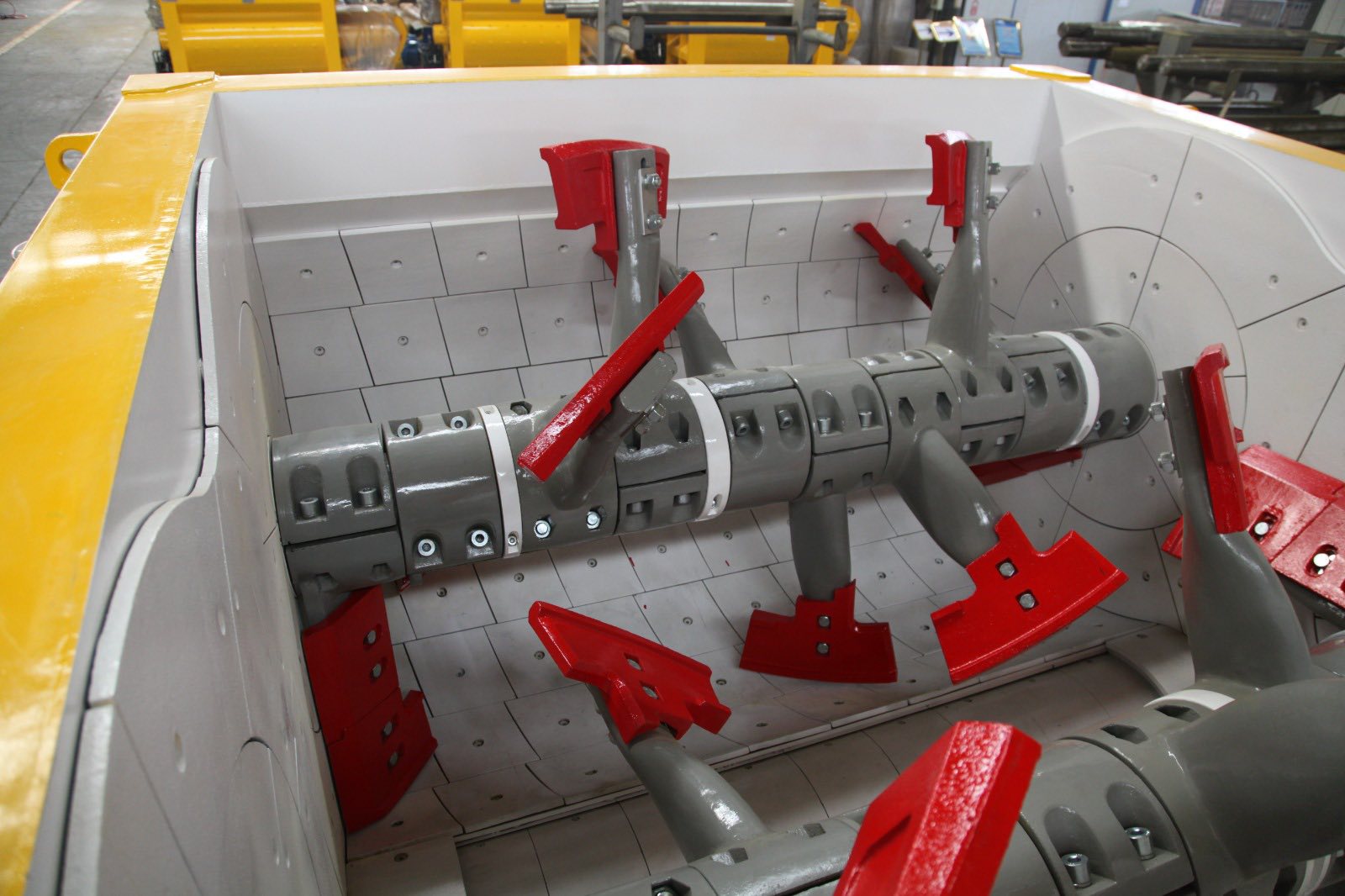
Sealing and discharging mechanisms form a complete operational loop. Shaft ends feature continuous protection systems: the JS series twin shaft mixer employs a dual-seal configuration (lip seals plus gland packing) supplemented by periodic manual lubrication to create a protective barrier, while the SICOMA MAO series twin shaft mixer utilizes multi-layer floating seals and an automatic centralized lubrication circuit to maintain a dynamic grease film, keeping slurry leakage risks below 0.5%. Upon completion of mixing, hydraulic cylinders drive the discharge gate to open at a wide 130° angle; for the mainstream SICOMA MAO 2m3 model, discharge is completed in under 10 seconds with no significant material residue remaining in the chamber.
Years of project experience show that on-site attempts to boost output by compressing mixing cycles to under 50 seconds often bypass the critical stabilization phase, leading to a more than 10% increase in concrete strength variability. Users can select the appropriate equipment based on their specific operational needs: the JS series twin shaft mixer offers cost-effectiveness for standard batch production, whereas the SICOMA MAO series twin shaft mixer ensures long-term operational stability for high-grade, continuous production scenarios.


