
Many people's understanding of the working principle of a twin-shaft concrete mixer is limited to "two shafts rotating in opposite directions to mix materials." However, from an engineering mechanics perspective, its essence is a process of material homogenization under the step-by-step transfer of mechanical energy and the coupling effect of multi-dimensional flow fields. In my years of experience, I've found that many projects experiencing insufficient homogenization, high energy consumption, and rapid wear are not rooted in insufficient equipment power, but rather in a lack of understanding of the underlying mixing principle. Based on the design practices of Haomei's JS and SICOMA series, this article dissects the core working principle of the twin-shaft concrete mixer from two dimensions: energy path and mixing mechanism.
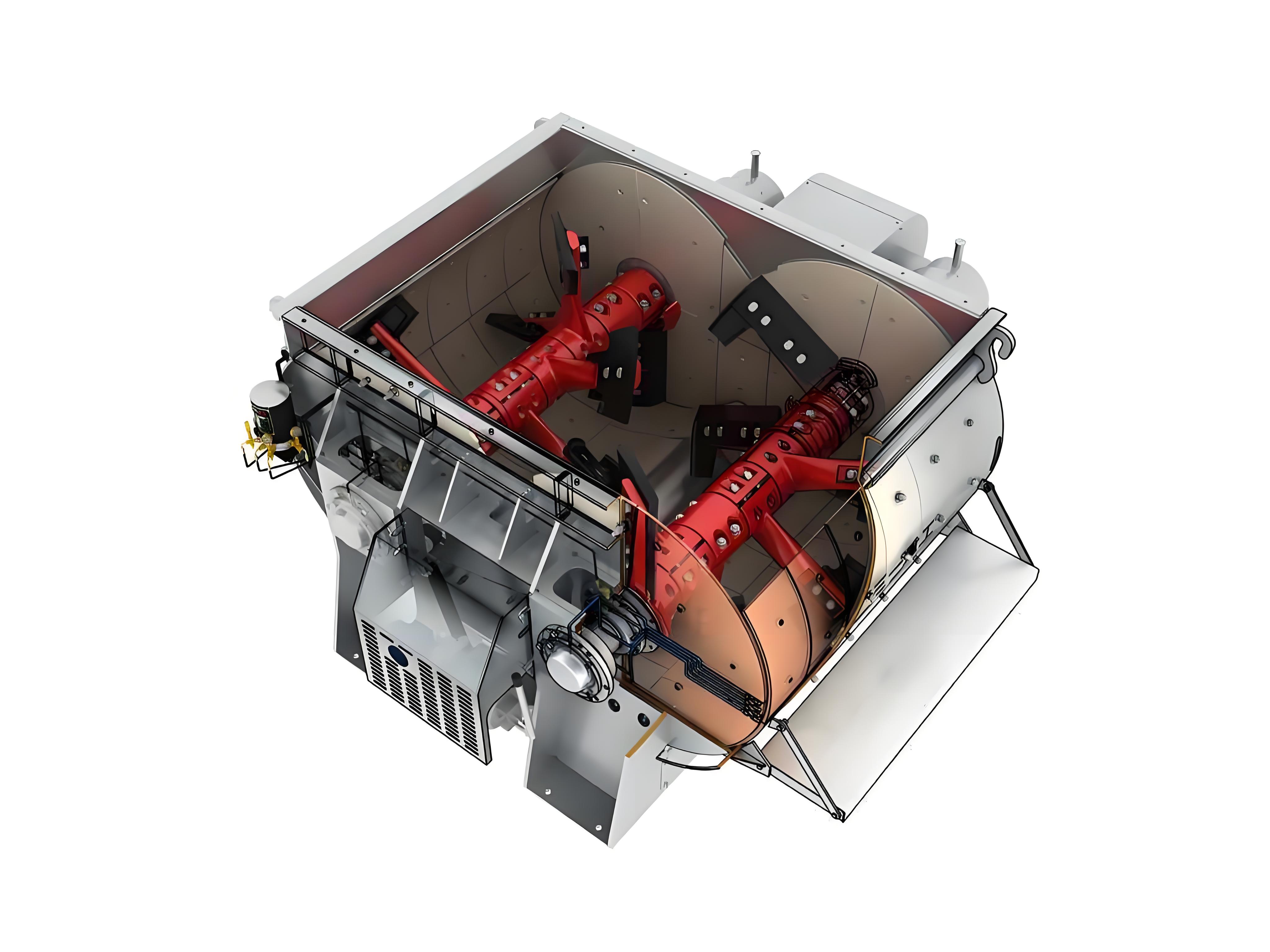
The step-by-step transfer of power energy is the fundamental prerequisite for mixing operations. The energy starting point of the twin-shaft concrete mixer is the mixing motor. Electrical energy is converted into rotational mechanical energy by the motor, and then the torque is amplified by the reduction mechanism before being transferred to the two main shafts. The JS series uses a standard planetary reducer with a flexible coupling for transmission, achieving an overall transmission efficiency of approximately 88%. It features a mature structure and universal spare parts. The SICOMA MAO series mixers use a coaxial direct-drive heavy-duty planetary reducer, eliminating intermediate coupling losses and achieving a transmission efficiency of over 95%, with an 8% increase in output torque at the same power. The main shaft drives the mixing arms and blades in a circular motion, applying mechanical energy to the mixture of sand, cement, water, and additives within the cavity. This mechanical force overcomes the internal friction and cohesion of the materials, achieving uniform mixing.
The core mixing process is accomplished through a three-pronged mechanism, rather than a single rotary stirring. The first mechanism is radial shear convection. When the dual shafts rotate in opposite directions, the blades drive the material to form two opposing flow streams within the cavity's cross-section. These streams converge and collide in the center, generating a strong shearing effect, which is the core driving force for breaking up powder agglomerates and achieving coarse mixing. The industry-optimal pitch-to-diameter ratio range is 0.72~0.78, with the SICOMA series concrete mixer precisely controlling it at 0.74. This achieves the highest efficiency in biaxial flow field superposition and eliminates dead zones in the middle of the mixing area. The JS series concrete mixer has a pitch-to-diameter ratio of 0.80, resulting in slightly weaker shear strength but better throughput for large aggregates. The second stage involves axial circulation and pushing, with blades arranged at 35°~40° axial angles. As the material rotates, it is pushed back and forth along the main shaft, achieving material exchange between the front and rear ends and preventing material accumulation at the ends. The third stage involves vertical tumbling and dropping, where the blades lift the material to the upper part of the cavity and then drop it freely, further improving homogeneity through gravity diffusion. These three mechanisms work together to achieve homogeneous mixing of C10~C80 grade concrete within 60~90 seconds.
From a temporal perspective, the mixing process exhibits clear staged characteristics. The first 20 seconds are the coarse mixing stage, where aggregates and powders are initially mixed, and large clumps of material are broken up. The middle 30-40 seconds are the main homogenization stage, where shearing and convection are fully utilized, and the cement paste evenly coats the aggregate surface. The final 10-20 seconds are the fine mixing and stabilization stage, where admixtures are fully dispersed, and the workability of the concrete tends to stabilize. My personal industry assessment is that many sites, in an effort to unilaterally increase production, compress the mixing cycle to less than 50 seconds, effectively skipping the fine mixing and stabilization stage. This can lead to an increase in concrete strength dispersion of over 10%, which, in the long run, increases the risk to project quality.
Overall, the working principle of a twin shaft concrete mixer is a product of the combination of mechanical structural design and fluid dynamics characteristics. The JS series and SICOMA series concrete mixers, based on different market positioning, have differentiated adjustments to the three mixing mechanisms: the former leans towards structural simplification and versatility, while the latter enhances shear efficiency and homogenization accuracy, respectively adapting to economic and industrial-grade production scenarios. Understanding the underlying principles before selecting equipment and adjusting production parameters is crucial to finding the optimal balance between production capacity, finished product quality, and operating energy consumption.


