
Twin-Shaft Concrete Mixer Specifications
Haomei Machinery's twin-shaft forced concrete mixers have established a complete specification system, covering two major types: JS series general-purpose economic type and SICOMA MAO series industrial-grade. From an engineering selection perspective, concrete mixer specifications are not simply a matter of volume, but rather a parameter matrix composed of four dimensions: nominal volume, power transmission, structural performance, and optional expansion.
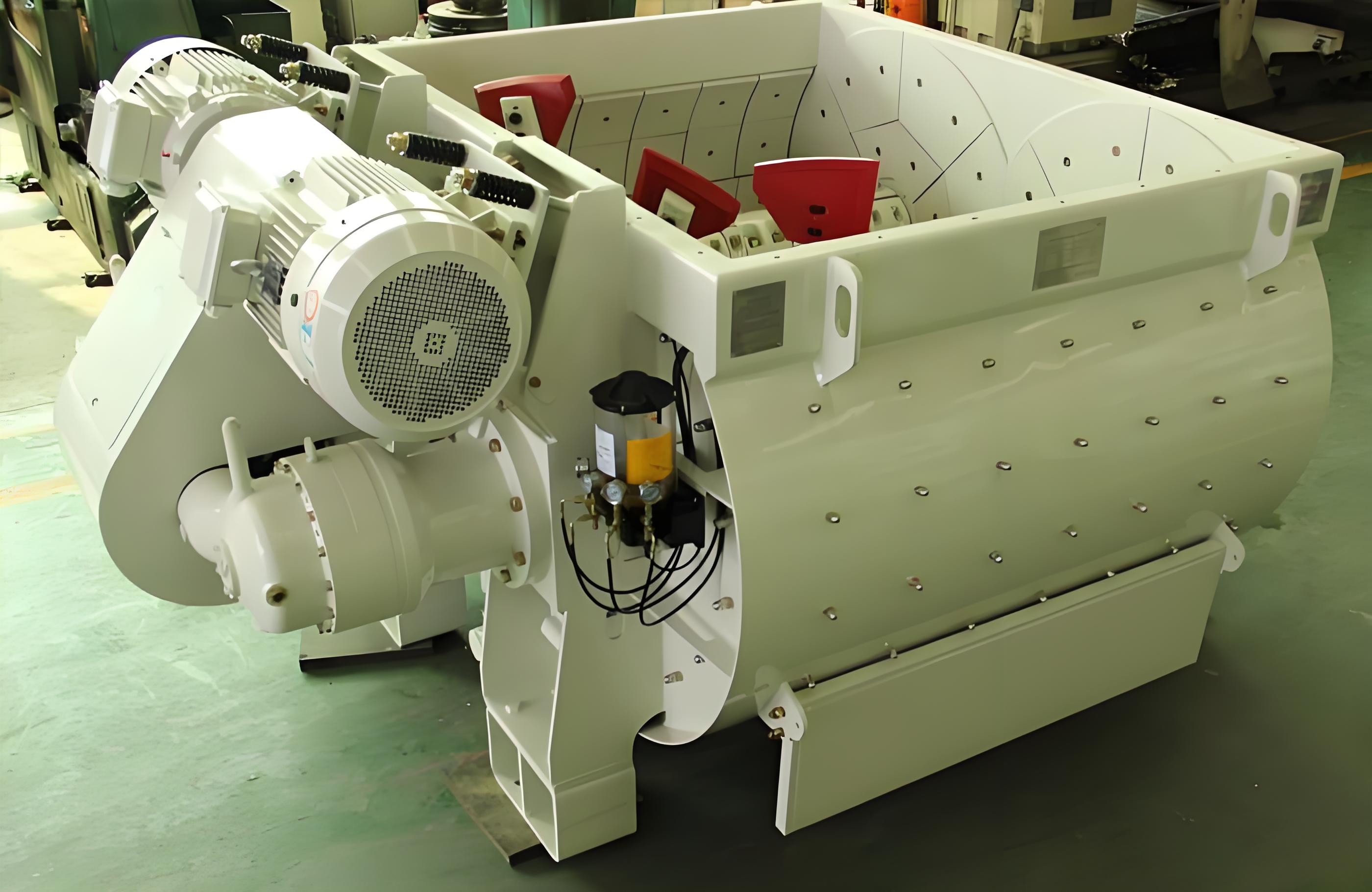
Nominal volume is the core benchmark for concrete mixer model classification, with both series forming a tiered capacity layout. The JS series concrete mixer includes five main specifications: JS1000, JS1500, JS2000, JS3000, and JS4000, with corresponding feed volumes of 1600L, 2400L, 3200L, 4500L, and 6000L, and dense concrete discharge volumes of 1.0m³, 1.5m³, 2.0m³, 3.0m³, and 4.0m³, respectively. Under standard working conditions, the theoretical hourly production capacity is 50m³, 75m³, 100m³, 150m³, and 200m³, respectively. The SICOMA MAO series concrete mixer corresponds to five models: MAO1000, MAO1500, MAO2000, MAO3000, and MAO4000. The nominal discharge volume is the same as the JS series, but the feed volume design is more conservative, at 1500L, 2250L, 3000L, 4500L, and 6000L respectively, achieving the same output capacity through higher mixing efficiency. Based on personal experience, models with the same nominal volume can have actual production rates differing by more than 10%, so selection requires comprehensive calculation based on actual mixing cycles.
The power transmission specifications determine the concrete mixer's load capacity and operating efficiency. The JS series concrete mixer is equipped with a three-phase asynchronous motor as standard, with power configurations increasing with specifications: 1m³ dual 18.5kW, 1.5m³ dual 22kW, 2m³ dual 30kW, 3m³ dual 45kW, and 4m³ dual 55kW, matched with a standard planetary gear reducer, achieving an overall transmission efficiency of approximately 88%. The SICOMA MAO series concrete mixer also adopts a dual-motor layout, with power configurations of 18.5kW dual motors for 1m³, 22kW dual motors for 1.5m³, 30kW dual motors for 2m³, 37kW dual motors for 3m³, and 45kW dual motors for 4m³. It features an original imported heavy-duty planetary reducer and a coaxial direct-drive structure, increasing transmission efficiency to over 95% and reducing energy consumption by 12%~18% for the same production capacity. Furthermore, the entire series can be customized with diesel engine drive solutions to suit off-grid field operations.
Core structural performance specifications are crucial for concrete mixer durability. The main shaft is made of tempered forged alloy steel. The JS series concrete mixer main shaft diameter increases from 120mm to 210mm with each specification, while the SICOMA MAO series concrete mixer main shaft diameter is increased by 10%~15% for the same specifications, significantly improving bending strength. Regarding shaft end sealing, the JS series concrete mixer uses a skeleton oil seal + packing dual sealing structure, while the SICOMA MAO series concrete mixer is upgraded to a multi-layer floating oil seal + automatic centralized lubrication system, resulting in a slurry leakage failure rate of less than 0.5%. Wear-resistant parts are also graded. The JS series concrete mixer comes standard with high-chromium alloy lined blades, with a hardness ≥400HB; the SICOMA MAO series concrete mixer uses Ni-Hard 530HB high-wear-resistant cast iron, increasing service life by more than 45%.
Optional extended concrete mixer specifications allow for scenario-based customization. The entire concrete mixer series supports optional high-pressure automatic cleaning systems, variable frequency speed control systems, intelligent metering and control systems, temperature monitoring modules, etc., with single modules costing an additional $800-$4000, allowing for flexible configuration based on project conditions.
Overall, Haomei Machinery's concrete mixer specifications system covers all levels of needs from economic to industrial grades. Engineers can precisely match the corresponding specifications according to capacity requirements, operating conditions, and budget standards, avoiding over-configuration or insufficient performance.


