
Concrete Mixer For Sale In The Philippines
Amid the Philippine infrastructure boom, the concrete mixer market is undergoing a technological revolution. While traditional vertical shaft planetary concrete mixers are still struggling with aggregate jamming, twin-shaft concrete mixers, with their unique three-dimensional forced mixing technology, are setting new construction standards in Philippine highway, bridge, and residential projects.
The unique geographical environment of the Philippine archipelago directly shapes the local preference for concrete machinery. The construction pace under the tropical climate, the complex gradation of aggregates, and the rigid requirements for concrete strength have collectively identified the most suitable machine type: the twin-shaft concrete mixer.
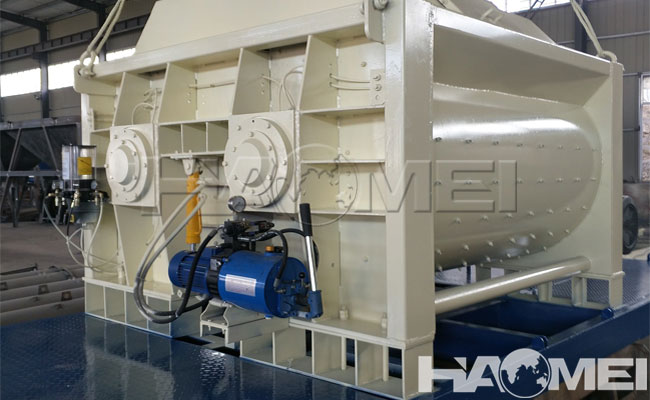
The models of concrete mixer for sale in the philippines are highly concentrated. Looking at our export data from the past year, the JS500, JS1000, and JS1500 models account for 78% of total orders. For small projects such as rural self-built houses or small-scale municipal repairs, the JS500 concrete mixer is the absolute mainstay, with a single output of 0.5 cubic meters. Equipped with a simple concrete batching machine, it can be used as a mobile concrete batching plant, and its 18.5 kW pure copper motor can operate stably even in remote areas with unstable voltage. In major cities like Manila and Cebu, almost all commercial concrete mixing plants have opted for the JS1000 and JS1500 concrete mixers. The former, with a capacity of 50 cubic meters per hour, perfectly matches the transport capacity of the commonly used 6-cubic-meter concrete mixer trucks in the area, while the latter is capable of handling large-scale bridge and airport projects. For example, the Davao Port cross-sea bridge project last year ordered eight JS1500 concrete mixers at once, which operated 24/7 without major issues.
The twin-shaft concrete mixer's success stems primarily from solving the core challenge of "homogeneity." Inside the U-shaped drum of a twin-shaft concrete mixer, two counter-rotating main shafts, along with the mixing blades, create a convection circulation. The material is forcibly sheared and tumbled in the intersection area between the shafts. Even special concrete mixed with volcanic ash can achieve a homogeneous state within 60 seconds, which is crucial for the Philippines' large-scale demand for construction projects with strengths exceeding C30.
Shaft end sealing is of paramount importance. Local sand and gravel have a high mud content, and ordinary seals leak within three days. The current system uses a composite structure of floating oil rings and mechanical seals, essentially giving the shaft end two layers of protection. Our JS series concrete mixer equipment has been used for over two years, and the seals are still intact upon disassembly and inspection.
Due to the inconsistent quality of local aggregates (with generally excessive mud content), the concrete mixer for sale in the philippines must possess strong wear resistance. Our customized JS750 twin-shaft concrete mixer for the Philippine market uses a high-chromium cast iron + rare earth alloy composite process for its liners. When mixing C30 concrete, the liner life reaches 28,000 cubic meters, a 40% improvement over the standard configuration. This technological adaptability is the key to the twin-shaft concrete mixer's success in the Philippine market.
The mixing blades also undergo special treatment. Instead of simple wear-resistant steel, a tungsten carbide layer is welded onto the wear-prone areas, extending the lifespan of the original blades by more than three times—considering that Philippine workers often use sledgehammers to hammer blades during replacement, this reinforced design can withstand such "rough handling."
There are also some details that particularly appeal to local users. For example, the outrigger height is customizable, adjustable from 2 meters to 4 meters. In the narrow construction sites of Manila's Old Town, where the concrete mixing plant can only be placed against a wall, the adjustable outriggers allow it to avoid underground pipelines. The lubrication system has been upgraded to fully automatic. Previously, workers often forgot to add lubricant, causing wear on the bushings. Now, it automatically supplies lubricant at set times, and there are reminders on the central control screen, making it easy for even less educated operators to operate. These changes may seem small, but they genuinely solve their construction pain points and are key to the continued popularity of twin-shaft concrete mixers.
From a technical perspective, the advantages of twin-shaft concrete mixers go far beyond high efficiency and durability. Its forced mixing characteristics make it highly adaptable to various materials. It can stably mix river sand, sea sand, and even recycled aggregates commonly found in the Philippine market. Its energy consumption is also about 15% lower than planetary mixers of the same capacity. At 8 pesos per kilowatt-hour in the local area, a single JS1000 concrete mixer can save nearly 100,000 pesos in electricity costs per year, which is very attractive to cost-sensitive small and medium-sized contractors. More importantly, its modular design is particularly well-suited to customs clearance and transportation in the Philippines—large models can be disassembled into main units, outriggers, and control systems for container loading, and then reassembled on-site, saving 30% on shipping costs compared to transporting the entire machine and avoiding Manila's port restrictions on oversized equipment.
Once, while debugging equipment at a concrete batching plant in Cebu, the owner remarked to me, "Before, when we bought European equipment, it would take two months to get spare parts when it broke down. Now, with China twin- shaft concrete mixers, there's a parts center in Manila; we can report a problem one day and have someone come the next." This hit the nail on the head. No matter how advanced the technology, it's useless without local support. Many manufacturers have now set up service points in the Philippines, even updating their operating manuals to bilingual English and Tagalog versions, and even releasing short video tutorials to teach workers maintenance step-by-step.
With the advancement of the Philippines' "Build, Build, Build" program, the demand for high-capacity models is sure to increase. Inquiries for models like the JS2000 and JS3000, with a capacity of over 100 cubic meters per hour, have already begun. But no matter how the model is upgraded, the technical logic of "understanding market demand and solving practical problems" of the twin-shaft concrete mixer machine should always be the mainstream in the Philippine market - after all, for construction companies, equipment that can reliably produce work and save money and worry is the real good equipment.


